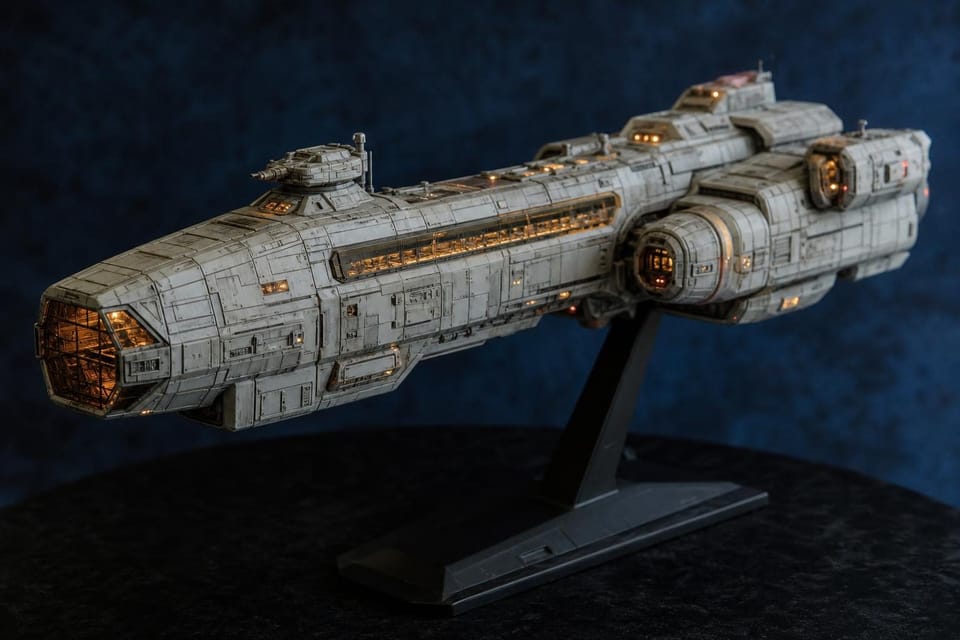
Nobody can tell you the engine on a Star Destroyer is the wrong shade of grey, and that freedom is exactly why science fiction is the most playful corner of the hobby. A spaceship, a robot or a fantasy creature has no reference photograph to correct you, so the rules loosen. The techniques are the same as any other subject; the permission is not.
Licensed kits and where they come from
Film and television subjects are sold as licensed kits by several makers, and the range changes as licences move. Bandai holds a large line of Star Wars kits, in several scales from the large vehicles at 1/72 to small 1/144 models. Star Trek starships have been produced by Polar Lights, now part of Round 2, and others. Aliens, creatures and robots from anime and film are also sold, though a given subject can go out of production for years.
Quality varies, and a licensed kit is often simpler than an aircraft or armour kit of the same price, because the subject is designed for easy assembly. That makes them a good first model. Check reviews and box art before buying; secondhand boxes of older kits are common at club shows and can be bargains or dead ends.
Colour guidance on the instructions is usually brief. The decals guide helps with the panel markings that many film kits supply, since a Rebel fighter without its squadron stripes is a plain grey shape.
Gunpla and snap-fit kits
Gunpla, the plastic model line from Bandai that began with a 1/144 RX-78-2 Gundam in 1980, is the largest snap-fit family. The kits are moulded in colour and clip together without glue, and many have articulated joints that let the finished robot hold a pose. Bandai sorts them into grades: High Grade (HG) is 1/144, Master Grade (MG) is 1/100 with an inner frame, Real Grade (RG) is a more detailed 1/144, and Perfect Grade (PG) is 1/60 and the most complex.
You can leave them unpainted, and the finish improves in a few simple steps. Cut parts from the runner with a sharp side cutter and shave the nub with a knife, because the white stress mark that a blunt cut leaves is the most visible flaw. Run a panel-lining pen, such as Gundam Markers, along the grooves, and sand the cut marks lightly. A coat of matt varnish removes the plastic shine and reduces the toy look.
Painting is optional but rewarding. Gunpla takes airbrush and brush alike, as the airbrushing guide shows, and snap-fit joints need care: paint thickness inside a joint stops it working. Mask the connecting surfaces or scrape them clean afterwards.
Choosing a first sci-fi kit
Size and finish both matter when you pick. A small 1/144 snap kit is finished in an evening and costs little, so it is a low-risk way to find out whether you enjoy the subject. A large starship at 1/350 or bigger is a different commitment: it needs shelf space, long painting sessions and usually a lighting plan. The scales guide explains how the number on the box translates to a length you can measure.
Look at the plastic before buying if you can. Soft, glossy plastic with deep panel lines suits washes and a light touch, while hard grey styrene takes sanding and filler well. Some kits are moulded in several colours and need little paint; others are single-colour and ask for a full scheme. Either is fine, but knowing which one you have saves a rethink halfway through.
Decide early whether the model will be built out of the box or customised. A box build keeps the designer’s look and a clean finish. A customised build changes the paint scheme, adds lights or swaps parts, and needs the planning of a larger project from the first cut.
Lighting with LEDs
Lights make a spaceship more than a shelf ornament. Small surface-mount LEDs on thin wires, fed from a button-cell holder or a USB lead, fit inside most hulls. Drill a channel for each wire, glue the LED behind a clear part or a thinned panel, and paint the inside of the shell black first. Plastic is usually thin enough to leak light, and a coat of silver behind the black reflects more of it forward.
Plan the wiring before the hull closes. Run wires along a spine or the bottom, and leave a hatch or a removable panel for the battery. Warm white suits cockpits and windows, cool white suits engines, and a dab of orange or blue paint over the LED tints it to taste. A resistor sized for the supply voltage protects the LED, and the packaging of any LED set states which one to use.
Test every light before sealing the model. A bulb that fails afterwards means a cracked hull.
Kitbashing and greebling
Kitbashing builds something new from the parts of other kits. A tank’s running gear becomes a landing leg, a spare engine becomes a reactor, and a few sprue offcuts glued on a flat hull look like machinery. The small details added to a large surface are known as greebling, a term from the film-effects workshops, and the trick is restraint: put detail where an engineer would, in clusters, and leave clean surfaces between.
Sort your spare parts into a box, and take a trip to a show’s trade tables where bags of leftover sprues are sold cheaply. Fix everything with the right glue and prime the lot together, so a mix of old kits reads as one object. A paint scheme with two or three colours holds a bashed model together better than detail does.
Weathering and colour
Science fiction takes weathering readily, because dirt tells the story. Chip the edges where crews would knock the paint, add soot behind engine nozzles, and run a dark wash along the panel lines. The weathering guide covers the techniques; for spaceships use colours that suggest long use, such as carbon black, rust brown and grey-blue.
Keep the lighting in mind while you weather. A model that sits in a dark corner needs stronger contrast than one in daylight. When you have finished, the subjects hub offers the other genres, and the aircraft guide is the natural next step for anyone who wants to try accuracy as well as imagination.