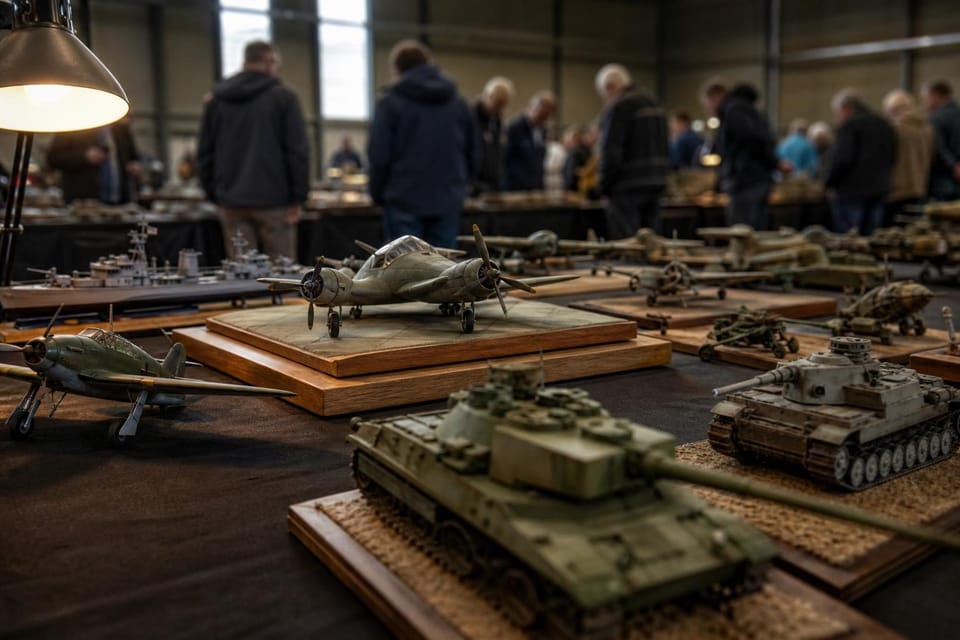
It is nine in the morning, the hall doors have just opened, and the first thing you notice is the smell of fresh coffee drifting over rows of trestle tables. On one table sits a 1/72 Spitfire with a sun-bleached finish. Two metres away, a diorama of a burnt-out Tiger tank occupies half a door. That is a normal start to a Saturday on the model shows UK clubs have been staging for decades.
This guide profiles the recurring shows that make up the circuit, explains what actually goes on inside the hall and sets out how to plan a first visit. It also covers the competition tables and how to enter them. Dates move from one edition to the next, so treat the usual month as a pointer and always confirm the current details on the organiser’s own page before you set off.
Scale model shows UK: the recurring events
Most British shows are run by local clubs, often branches of IPMS (UK), the society for plastic modellers. They are hired-hall affairs: a sports hall or leisure centre, a few dozen trade stands, club display tables and a competition. The big exception is Scale ModelWorld, which sits at the top of the pile.
Scale ModelWorld, Telford
Scale ModelWorld is held over two days in early November at the Telford International Centre in Shropshire. Organised by IPMS (UK), the society describes it as the largest fine scale model show in the world. Its own figures run to over 100 traders, over 100 branch displays and more than 90 Special Interest Group displays, plus a separate area for overseas clubs. Manufacturers often use it to unveil major new kits. A longer profile sits on the Scale ModelWorld page, and the society’s own information is at ipmsuk.org.
Romsey Scale Model Show
IPMS Romsey runs a one-day show at Crosfield Hall in Romsey, Hampshire, in July. The 2026 edition was billed as the ninth annual show, which makes it a younger event than some, and its organisers describe it as featuring the south coast’s best model clubs and trade stands. It has an on-table competition and a charity tombola. Details are on the IPMS (UK) calendar entry.
IPMS Plymouth Model Show
The Plymouth show takes place on a Saturday in July at the John Kitto YMCA Centre on Honicknowle Lane in Plymouth. The entry describes it as model clubs and traders from across the South West displaying and selling models in various scales. It suits anyone in Devon or Cornwall who would otherwise face a long drive to the Midlands. The listing is on the IPMS (UK) calendar.
Aberdeen Scale Model Show
Scotland’s north-east has its own scale model show at Curl Aberdeen, listed for a Saturday in late August in recent years. It is the main fixture for modellers in the region and for visitors who combine it with a trip to the city.
IPMS Salisbury Model Show
IPMS Salisbury’s show has recently been listed for late May at the Wyvern St Edmunds Sports Hall in Laverstock, near Salisbury. It sits in the busy spring run of Wiltshire and Hampshire events, which makes a weekend of two shows possible for anyone based in the south.
IPMS Bolton Show
Bolton opens the calendar in January, and one modelling writer has called it arguably the best one-day show in the country. Club displays and vendors attend in numbers, and modellers from the Midlands and the North West make the trip. It is a useful cure for the post-Christmas lull.
Modelfest, Fleet
IPMS Farnborough runs Modelfest at the Hart Leisure Centre on Emerald Avenue in Fleet, Hampshire. It has been held on a Saturday in September, with free on-site parking and refreshments. Besides the host club’s work, it features displays by IPMS and non-IPMS clubs from a wide area.
How a club show differs from the national event
The difference between a club show and Telford is mostly one of scale and of purpose. A regional show is a day out: you can see every table, speak to most of the traders and be home for tea. The national event is a weekend, and plenty of visitors book a hotel, split the two days between halls and still miss something. Both are worth knowing, and anyone serious about scale model shows UK wide will end up using both, the local one for regular contact with a club and the big one for the stock and the spectacle.
The subject mix shifts too. A small hall is dominated by the host club’s interests, so a branch with a strong armour group will fill its tables with tanks, while another leans towards aircraft or ships. At Telford the Special Interest Groups spread the coverage far wider, from a single aircraft family to sci-fi and fantasy. If you build one subject only, a local show may show you more of it per square metre than the national event does.
A third difference is who stands behind the tables. At a branch show most traders are regulars who know the members by name, and many take pre-orders to hand over on the day. That is a quiet advantage if you want a specific kit and do not want to hunt for it.
Between them, these events create something close to a year-round calendar: Bolton in the first weeks of the year, Salisbury in late spring, Romsey, Plymouth and Aberdeen across the summer, Modelfest in early autumn and Telford to close the season in November. Other clubs fill the gaps, and the club finder shows who is local to you.
What happens at a show
A show has four parts, and each rewards a different kind of attention. The scale model shows UK clubs put on follow a similar pattern: club tables, traders, a competition room and a café queue.
The club displays are the heart of it. Branches and Special Interest Groups set out a table of members’ work, often with a theme: a single aircraft type, a campaign, a ship class, a scale. This is where you see what an experienced hand does with a kit you may already own on the shelf.
The trade stands are where the money changes hands. Independent retailers, resin and photo-etch specialists, paint and tool suppliers, decal printers and second-hand dealers set up along the hall. Stock at a show is often broader than a high-street shop will ever carry, and older kits turn up in boxes you cannot find online.
The competition tables are the third part. Entries stand on staged benches, arranged by class, with entry cards beside them. Visitors can walk the tables freely, even if they have not entered a model themselves, and reading what has won in each class is an education in what judges reward. The page on how competitions work goes through the classes and judging in detail.
Finally there is the social layer, which is what regulars come for. Bring-and-buy tables, kit swaps, demonstration corners and a canteen that serves bacon rolls all feed an hour of chatter about glue, primer and the latest release from Tamiya or Airfix.
Subject areas you will meet
Aircraft are the largest group at most UK shows, which suits a country with such a deep aviation history, and the aircraft guide covers the techniques that dominate those tables. Armour comes a close second, with dioramas that take in mud, foliage and ruined buildings, so the armour guide is worth a read beforehand. Expect ships, cars, figures and sci-fi in smaller numbers. Ship modellers bring waterline hulls on glass-effect seas, car builders bring mirror-gloss bodies that make the lighting in the hall look rough, and figure painters bring single busts that reward a slow, close look. Sci-fi tables tend to be the most playful, with Star Wars, Star Trek and original designs sharing space beside an Airfix Spitfire. None of it is off limits to a newcomer; ask the person behind the table which kit it came from, and the answer often saves an evening of searching.
A guide to planning a visit
Plan around the one thing that varies most: the opening time. Many club shows open at 10:00, though the Romsey listing shows 9:30. Telford lets members in an hour early, and the general public follows. Check the times on the organiser’s page. Most model shows UK organisers run are single-day events, so arriving at opening time gives the quietest hour at the tables.
Work out your route in advance. Club shows tend to be in sports centres with free or cheap parking, while Telford lists plentiful car parking on site. A small hall in a town centre may mean a short walk from wherever you leave the car.
Bring cash, because a hall with a thousand people in it does not always have a mobile signal for card readers, and a lot of traders still prefer notes. A tote bag, or better a stiff carrier box, protects any boxed kits from being crushed on the journey home. A tape measure helps if you are checking whether a new boxed kit will fit your display shelf, and the scale calculator will tell you how large a model comes out at a given scale.
Seasons matter as well. Winter shows draw people who have spent the autumn at the bench and want to see what others have finished. Summer shows compete with holidays, gardens and everything else, so halls feel quieter and conversations last longer. The autumn events are the busiest, with Scale ModelWorld as the peak. If you can only manage two visits in a year, one early in the calendar and one in November gives you a good spread of what is happening.
Decide what you are hunting for before you go. A list with kit codes, paint reference numbers and the decal sheets you need keeps you from coming home with eight impulse buys. If you are new, the first toolkit guide lists what is worth buying at a stand, and the scales guide is worth knowing before you ask a trader for “the 1/48 one”.
Eat early or late if the hall has a canteen, because the queue peaks around noon. Pace yourself as well, since three hours of browsing is more tiring than it sounds. Finally, speak to people. Modellers who built the models on the tables are standing right there, and the question “how did you paint that?” has launched more friendships than any club newsletter.
Entering a model show competition
A model show competition is the best way to get honest feedback on a build. Most shows with a competition publish their rules and classes in advance, and the usual route is simple: pick the class that fits your model, register if the show asks for it, hand the model in at the specified time and collect it at the end. At Scale ModelWorld, entries must be made before the show, and the competition is open to IPMS members, while other shows set their own rules on who may enter and whether entries can be made on the day. Always confirm the rules for the specific show. A first entry at one of the smaller model shows UK clubs run is a gentle way to learn how judges look at a model, and the scale model shows UK calendar has one within reach of most of the country.
Prepare the model as if the judge will pick it up. Check that the decals are sealed and free of silvering, that no fingerprints sit on a gloss coat, and that no loose bits rattle. Photograph the model first, because the transport home is where most accidents happen. A small stand or base makes the piece look finished, and a short card with the kit, scale and any conversions helps judges understand what you attempted.
Think about the paperwork as well. Some shows ask for entry forms ahead of time, others run a simple desk where you fill in a card on arrival, and a few split entries into pre-registered and on-the-day lists. Read the show’s own page for the closing date, because a missed deadline cannot be fixed at the door. For anyone planning a first model show competition entry, a club member who has entered before is the best guide to what the desk will ask.
Do not enter hoping to win. The more useful approach is to enter to learn: read the judges’ comments if the show provides them, look at what won your class, and note the standard of finish. The full explanation of classes, junior sections and judging criteria is covered in the competition guide linked earlier, and for a first entry, a modest kit built cleanly beats an ambitious one built badly.
If you are not ready to enter yet, begin by visiting. Find a branch near you through the club finder, ask what shows the members attend, and go along with them. Your next practical step is to pick one show from the list above, check its current date on the organiser’s page and put it in the diary.