A shelf is 300 mm deep and the kit you want is a bomber. The sum that decides whether it fits takes ten seconds: real length in millimetres, divided by the scale number. The calculator above does that for you, and the rest of this page is the arithmetic behind it, so you can check any result with a pencil.
How a scale ratio works
A scale of 1/48 means one unit on the model stands for 48 of the same unit on the real thing. One millimetre of plastic is 48 mm of aircraft. The number after the slash is the divider, and a bigger number means a smaller model.
That last point catches newcomers. A 1/72 model is smaller than a 1/48 model of the same subject. It is not half the size, because 48 divided by 72 is two thirds, so the 1/72 version is two thirds of the length. Halving the length needs a jump from 1/72 to 1/144.
Keep all lengths in one unit before dividing. Real vehicle sizes are usually quoted in metres or feet and inches, so convert to millimetres first: 1 metre is 1,000 mm, and 1 inch is 25.4 mm.
To go from real to model, divide by the scale number. To go from model to real, multiply by it. If the answer looks wrong by a factor of ten, the usual culprit is a unit slip between metres and millimetres.
Worked examples you can check by hand
The standard Spitfire wing spans 11.23 m (36 ft 10 in). In millimetres that is 11,230. At 1/48 the model wing is 11,230 divided by 48, which is 233.96, so about 234 mm. At 1/72 it is 11,230 divided by 72, or 156 mm. At 1/32 it is 351 mm, and at 1/144 it is 78 mm.
Now the reverse. A tank model measures 200 mm hull length at 1/35. Multiply 200 by 35 and you get 7,000 mm, which is 7.0 m, a believable hull length. Had the sum come out at 70 m or 0.7 m, the slip would be in a unit or a decimal point. Sense-checking the answer against what you know of the subject is half the skill.
Feet and inches need one extra step. The Spitfire wing above is 36 ft 10 in, which is 36 times 12 plus 10, or 442 inches. Multiply by 25.4 and you get 11,226.8 mm, the same 11.23 m rounded.
Ships show the effect at large size. A 200 m ship at 1/350 is 200,000 divided by 350, about 571 mm. The same ship at 1/700 is about 286 mm. Halve the scale number and the length doubles, which is why a 1/350 warship needs a deep shelf.
Figure heights at each scale
A 1.8 m person is a convenient yardstick for figures and crew. The table below gives that height and two further sizes at each scale; every figure is rounded to the nearest tenth of a millimetre.
| Scale | 1.8 m person | 5 m vehicle | 11.23 m wingspan |
|---|---|---|---|
| 1/144 | 12.5 mm | 34.7 mm | 78.0 mm |
| 1/72 | 25.0 mm | 69.4 mm | 156.0 mm |
| 1/48 | 37.5 mm | 104.2 mm | 234.0 mm |
| 1/35 | 51.4 mm | 142.9 mm | 320.9 mm |
| 1/32 | 56.3 mm | 156.3 mm | 350.9 mm |
| 1/24 | 75.0 mm | 208.3 mm | 467.9 mm |
Figures sold by height, such as 54 mm and 75 mm, sit close to 1/32 and 1/24. The label gives the approximate size of an adult, not a measured one. Sculptors measure differently, so two 54 mm figures from different makers rarely match exactly.
Checking the scale of a kit part
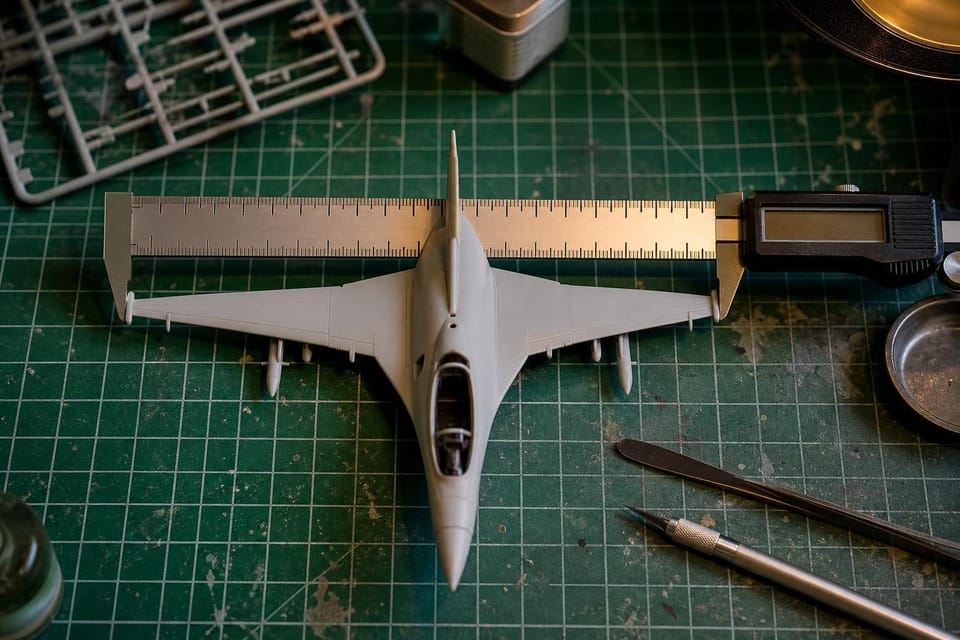
Boxes state a scale, and the parts do not always agree with it. Pick one dimension you can look up, such as a wingspan, a hull length or a wheel diameter, and measure the matching part with a steel rule or calipers. Multiply that figure by the scale number on the box. If the result lands within a few per cent of the published real size, the kit is true to its label.
Small differences are normal. Makers scale from drawings, and old moulds were often cut from rougher plans than modern ones. When a difference matters, as it does when two kits stand in the same diorama or one display case, measure both and plan around the real numbers.
Common scales by subject
Aircraft come mostly in 1/72, 1/48, 1/32 and 1/144, and the choice trades detail against shelf space. Armour is dominated by 1/35, with 1/72 and 1/48 the other popular options. Ships split between 1/700 for waterline fleet building and 1/350 for large detailed models, with smaller craft in bigger scales. Car kits are mostly 1/24, with 1/12 for big motorcycles and showpieces. Figures run from 1/35 through 54 mm and 75 mm to 120 mm and large busts.
Sci-fi and fantasy kits often have no real scale, since there is no real object to measure. The size printed on the box is the maker’s decision, so treat it as a rough guide. The scales guide goes into how to choose between them, and the subject pages for aircraft, ships and figures cover the preferences of each.
Railway gauges and scales, as context
Railway modellers use a related system, and the figures confuse people who move across. British OO is 1:76.2, with track 16.5 mm wide. Strictly, standard gauge scaled at 1:76.2 would give track about 18.8 mm wide, so OO has long run on narrower track than its scale implies. HO is 1:87 and uses the same 16.5 mm track, where the ratio and the gauge agree closely.
That is why OO figures and vehicles are a different size from HO ones, even though the track matches. If you are building a diorama with a railway, check which of the two the models are made for before mixing them.
For armour or aircraft in a layout, 1/76 and 1/72 are close enough that some builders mix them, though the sizes do not agree exactly. Measure a known dimension on the parts and decide by eye.
Next step: take the real length from a reference book, run it through the calculator at your preferred scale, and compare the result with the shelf before the kit goes in the basket.