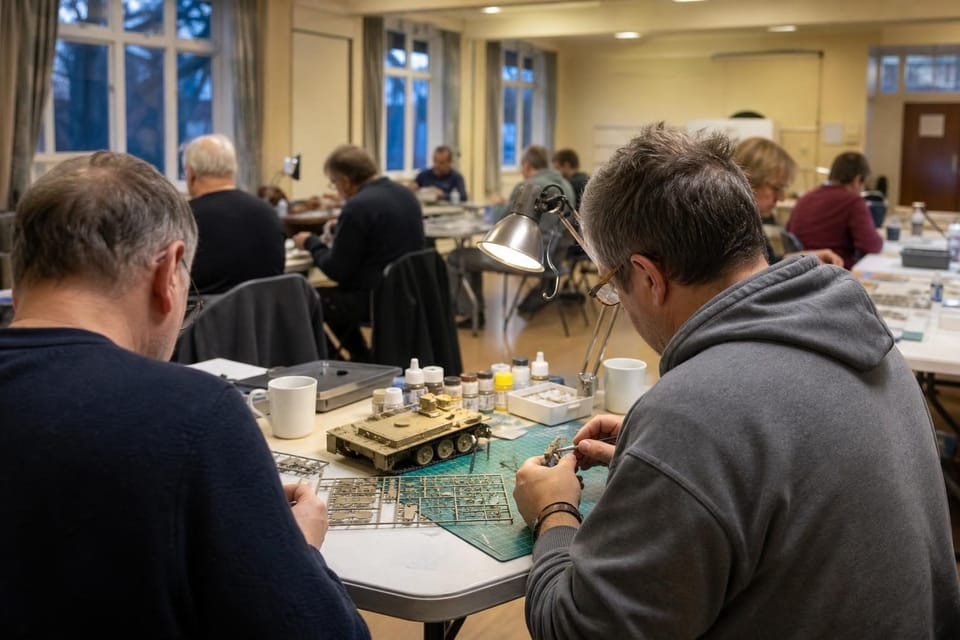
The kit has been on the bench since spring. The fuselage seam is still showing, the canopy is fogged, and the only person who might know why is someone in a room three miles away on a Thursday evening. That room is a modelling club, and for a lot of builders it is the quickest way to improve.
Model clubs UK wide: what happens on a club night
Most meetings are less formal than the word “club” suggests. People arrive with a kit in a box or a half-finished build in a carrier bag, claim a spot at a long table and carry on building. Conversation happens in bursts. Someone holds up a wing and asks whether the gap looks wrong, and three people have an opinion.
A typical evening has a short business item at the start, such as show dates or a subs reminder, then a long stretch of building and talking. Many clubs have a bring-and-buy corner for spare kits and a show-and-tell table where finished work goes for a look. Some hold a themed night: a painting demonstration, a group build, a talk on a particular aircraft or ship.
Meeting patterns vary. Weekday evenings, fortnightly or monthly, are the most common. A few clubs meet on a Saturday or Sunday afternoon, which suits people who do not like driving after dark. Rooms are typically church halls, community centres, scout huts or the back room of a pub.
Subs are normally modest and cover the hire of the room plus a few running costs. Each club sets its own, so ask the secretary at your first visit rather than guessing.
Scale model clubs UK: independent clubs and IPMS (UK) branches
Two kinds of group make up most of the list. Independent clubs are founded and run by their own members, often for decades, with their own committee, rules and traditions. Branches belong to IPMS (UK), the national society for plastic modellers, which also organises the Scale ModelWorld show at Telford; the society’s branches meet locally and are open to its members.
There is no rule that you must choose one. Plenty of modellers belong to a local independent club for the company and to a branch for the national connection, and nobody minds. What differs more is character. A small club that has met above the same shop for thirty years feels different from a larger branch with a newsletter and a programme of speakers.
Some groups also build around a theme rather than a place: a scale model clubs UK scene includes clubs for aviation modellers only, armour groups, ship and naval clubs, and car builders. A general club will have all of these at one table, which is useful if you have not yet settled on a subject. For where subjects differ, see the subject guides.
Using the map to find a model club near me
The map on this page places clubs by area. Zoom to your town, check the clubs within a reasonable drive, and look at three things before deciding: when they meet, whether the venue has step-free access and parking, and what kind of modelling the members actually do.
Searching for a model club near me works best in two passes. First pick two or three on the map that fit your evenings. Then look for each club’s own contact details, send a short message and ask for the next meeting date. Clubs change venue and nights more often than lists catch up, so a confirmed answer from the person who runs it beats any listing.
If the nearest club is too far for a weekly trip, a monthly meeting is still worth the journey. A club that meets once a month often holds longer sessions with a bring-and-buy and a talk, which can be a better use of a Saturday than a short weeknight.
Special interest groups, juniors and club tables
Within bigger clubs and branches, special interest groups form around subjects: Luftwaffe aircraft, Eastern Front armour, Napoleonic figures, Cold War jets. The group usually shares reference books, swaps decal sheets and runs its own small competition or group build. If you only care about one thing, finding that group is more useful than the general meeting.
Juniors are welcomed by some clubs and politely redirected by others, often for reasons of venue rules or safeguarding. Where a club does take young builders, a parent normally stays. Ask first and the club will tell you how it handles it.
Good model clubs UK wide also take tables at shows, where they display members’ models and often stage a group collection around a theme. Walking round a model show and talking to the people behind the club tables is one of the easiest ways to meet a group before going to its meeting room. The biggest of them all is Scale ModelWorld, where clubs from all over the country exhibit. Entering the competitions is something many clubs do as a group, with members sharing lifts and a table of entries.
Online forums or the room itself
Forums and social media groups are excellent for answers at any hour, and a good thread on a tricky camouflage pattern can save a weekend. What they do not give you is someone able to look at the model in front of them. Gloss, texture, a warped part, a seam that looks fine in a photograph and awful in daylight: these are easier to judge in person. Model clubs UK wide tend to welcome both: plenty of members post their builds online and still turn up on club night.
A reasonable arrangement is to use both. Ask questions online, then take the same problem to a club night and let someone pick the model up. Many clubs also run their own groups, which is a gentle way to see how members talk to each other before you commit an evening.
Walking in for the first time
Message the contact person beforehand and say what you are building. Take something with you, preferably unfinished: a work in progress starts conversations faster than a perfect model does. Take your own cutter and tweezers if you plan to work, and a modest amount of nerve if you do not. Model clubs UK members run are used to visitors, and the scale model clubs UK listings on this page give the night each one meets, so a first visit takes one message at most.
Do not expect to be quizzed. Newcomers are usually welcome because clubs depend on new members, and the questions you will actually be asked are friendly ones: what scale, what subject, how long have you been at it. A model club near me on the map can still turn out to be the wrong fit, so try the second one on your list; clubs differ a lot in atmosphere.
If you have not yet got a toolkit together, the beginner’s guide sets out what a first kit needs, and the weathering guide is a good one to read before your first show-and-tell.